

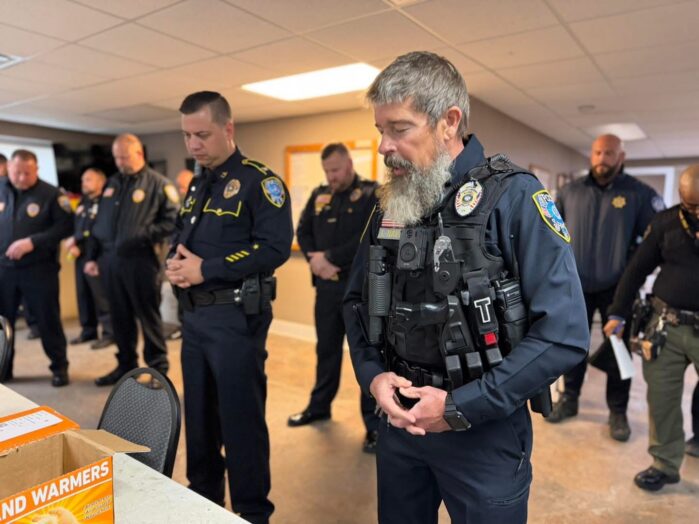
In the proud and illustrious 109-year history of the New Orleans Baptist Theological Seminary (NOBTS), Jeff Nave is most likely the first and only professor to get tasered while on sabbatical.
“And no, it definitely was not pleasant,” he says. “Getting tasered, getting pepper sprayed, being forced to do hundreds of pushups while someone yelled obscenities at me—I never imagined that’s how a 47-year-old seminary professor would be spending his summer break.”
“But it turned out to be one of the best things I’ve ever done.”
Since 2011, Jeff Nave, Professor of Counseling at NOBTS, has served as a chaplain for the Slidell (Louisiana) Police Department, where, in 2015, after attending and graduating from the police academy there, he was also commissioned as a reserve police officer.
“Taking my sabbatical to go to the academy opened so many doors,” he says. “Cops can be cynical people, but now, I can’t tell you how many times since I graduated that I’ve encountered someone when I’m in uniform and they’ll ask, ‘Whoa, wait—you’re a commissioned police officer?’ and I’ll answer yes, and then the very next question is, ‘So, you’ve been tasered?’ and my answer is, ‘Yes.’”
Professor Jeff Nave—now also, Public Service Chaplain and Reserve Police Officer Jeff Nave—lives for moments like that. “They’ve just recognized what I was willing to go through to do the work of a chaplain, and I can just see it on their face—that realization of, ‘Hey, this guy really cares about me.’”
“Would you ever consider…?”
Like many longtime residents of metro New Orleans, Jeff Nave’s life took an abrupt turn in August 2005. “I’d been teaching since 1999, but after Hurricane Katrina, I started doing counseling work with folks in law enforcement,” he says, “and after I’d done that for a few years, a member of my church who was a police officer approached me and said, ‘Would you ever consider becoming a chaplain for our police department?’”
At the time, chaplaincy was not a completely foreign concept to Jeff. “When I was in my 30s, I’d looked into it,” he says, “but my wife and I had young kids then, and the timing wasn’t right, so from that point on, I just figured the opportunity had passed me by.”
He figured wrong. Jeff kept his day job at the seminary but jumped at this second chance at chaplaincy. Just a few short weeks after that police officer’s “would you ever consider” proposition, he was riding shotgun in patrol cars and settling into the daily rhythms of life at the Slidell Police Department.
“Patrol officers here work two weeks of days then two weeks of nights, and they always start their night tour on a Friday evening,” he says, “so, I committed to be there every Friday night to pray with them, spend time with them, and then ride around with them into the wee hours of the night.”
Riding with Slidell’s Finest
If it’s true that police work is, as the saying goes, “hours of boredom punctuated by moments of terror,” Jeff discovered that not just the terrifying moments, but the empty hours were fertile ground for deep conversations.
“There’s something about spending 12 hours a night in a vehicle with somebody,” he says. “I don’t care who you are—when you ride around in a patrol car with a guy for an entire shift, they’ll open their entire life to you.”
“And I found out pretty quick—these cops had a lot to talk about.”
After 15 years of ride-alongs, Jeff has now developed a healthy appreciation for Slidell’s finest—“this is a career they chose because they care about people,” he says—but still, the long hours, low pay, and constant exposure to the worst the world has to offer can make police work complex, dangerous, and destructively hard on families.
“At the academy, they told us that 75% of cops demonstrate problem drinking behavior at some point in their career,” he says. “The divorce rate in my department is way over 50%. I have guys coming to me in the midst of all their brokenness—they know what’s wrong, they want to do something different, but they don’t know what.”
“And as sad and tragic as that is, it opens the door for gospel conversations.”
Police Station Sunday School
Now, in settings where historically they’ve never been commonplace, gospel conversations come all the time—sometimes when Jeff least expects them.
“Not long ago, everybody was at the station on a slow Friday night,” he says. “No calls had come out, and one of our guys said to everybody, ‘I’m taking tomorrow night off because my wife and I are going to this musical. I can’t remember what it’s called—something about a guy named Joseph, I think.’ And I said, ‘Is it Joseph and His Technicolor Dreamcoat?’ and he said, ‘Yeah, that’s it.’ So, I asked all the guys, ‘Do you know the story about Joseph and his coat of many colors?’”
“So many of my cops are biblically illiterate, and none of them had ever heard of Joseph. So, I told them the story. No calls came in over that time, and I ended up basically teaching an impromptu Sunday School lesson right there to a room full of cops.”
“Suddenly, the Bible was not an abstract concept to them. It was a real book with a real story about a real person who lived a life that has lessons for us today.”
“When you’re a chaplain, God opens doors for conversations like that all the time.”
Bearing Fruit
It didn’t take long for word about Jeff to get out.
“Northshore Church in Slidell, where I also serve as an associate pastor, started hosting the local Police Academy graduation, and they’ve even begun putting some money into the budget for ministry to police officers,” he says.
“They’ve been so supportive of my ministry, especially now that it’s begun to grow.”
A Public Service chaplain who’s also a counselor, an associate pastor, and a commissioned law enforcement officer is a rare and sought-after commodity. “The state police heard about what we were doing in Slidell and came to me because they’d been looking for someone with law enforcement training and also professional counseling training,” he says.
“Now, they asked me, in addition to being a chaplain for the Slidell Police Department, to serve on a crisis negotiation team.”
“So, those skills I developed a long time ago as a counselor, all that time I’ve spent riding shotgun in police cruisers, even getting tasered at the police academy—I can see now how it all fits together with everything I have the opportunity to do. It’s all bearing fruit.”
Bearing fruit might be more important now than it’s ever been, because Jeff says working in law enforcement is not what it used to be.
“The public’s perception of police work has changed, and I wish people understood how brokenhearted cops can get now,” he says. “Yes, I recognize that there are bad cops out there that do bad things, but the police officers I know have a real passion to serve their community, and when they purpose to do good, only to have someone think they’re intentionally doing bad—I think that’s one of the most difficult things a person can experience.”
“That’s ultimately why I do what I do. I want these men and women to know Jesus cares for them, and I do too.”
A Call to Action
Endorsed SBC public service chaplains like Jeff are desperately needed in communities all across North America. “Being endorsed is so important,” Jeff says. “It connects me with other chaplains and opportunities for growth. It provides much-needed accountability, because I’m often asked to take unpopular positions on cultural issues. And it also gives me credibility. Being endorsed allows me to go where others can’t and share the gospel with people not everyone can reach.”
Learn more about how you can become an SBC-endorsed chaplain.