Uncle Sam didn’t want him.
Of that, Daniel Garnett, the son of Tech Sgt. Steve Garnett, U.S. Air Force (Ret.), was certain. “Growing up, I never once aspired to follow in my father’s footsteps,” he says, “so I was certain the military life just wasn’t for me. I mean, by the time I was 16 and God called me to ministry, I’d never even camped outside—not ever, not a day in my life.”
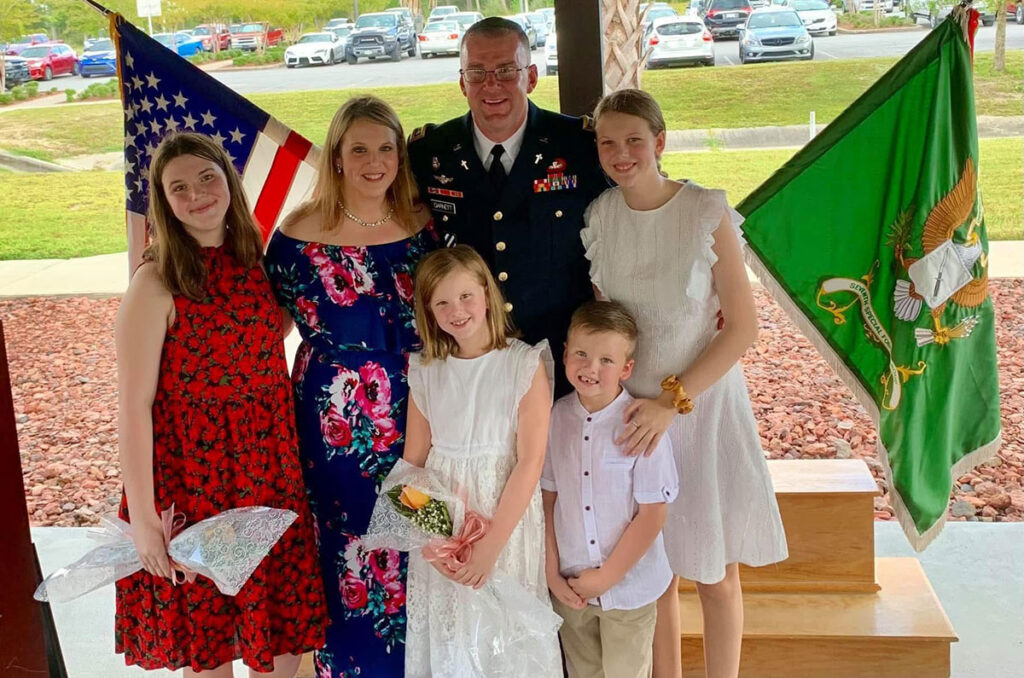
And yet now, every morning when Chaplain (Major) Daniel Garnett, U.S. Army, opens his chest of drawers, he’s greeted by a closetful of olive drab fatigue-shaped reminders that God’s plans are often different—and always better—than our own.
“He’s the one who writes our stories,” he says. “That means we always have to be ready for Him to interrupt our lives and lead us down a different road.”
“That’s certainly what He did with me.”
Plane Talk
Daniel Garnett’s road to becoming a military chaplain began, innocently and unexpectedly enough, on an airplane. “I’m an introvert and so when I get onto a plane, I typically don’t talk to people,” he says. “But in the summer of 2011, I was on this flight to Atlanta, and I really felt the Lord pressing me to talk to this man who was sitting next to me. It was crazy because, like I said, that never happens. But I struck up a conversation with this guy and I asked him, ‘What do you do for a living?’ and he said, ‘I’m an active-duty military chaplain.'”
“When he said those words, I can’t explain what happened. I started asking him all kinds of questions, and as we got to talking, it’s like some kind of fire got lit inside me, and I just knew—this is what God had for me.”
For almost as long as he could remember, ministry had been a significant part of Daniel’s life plan—”For years, I’d been telling people, ‘All I know is pastoring,'” he says—but military chaplaincy had never appeared on his radar. And yet, when he got off the plane, met his wife, and told her what happened, her response—”Let’s do it”—was all the encouragement he needed to move forward.
“God flung open every door imaginable,” he says. “Everybody says nothing happens fast in the military, but this happened fast. We began the process in August 2011, and by May 2012, we were driving to Fort Jackson in South Carolina, where I was welcomed into the Army as a chaplain.”
Everything up to that point had been easy. Most everything that followed would be hard.
Baptism by Fire
Three months after Chaplain Garnett’s first day on the job, his unit was deployed to Afghanistan. “When I went home and told my wife that’s what would be happening, I was like, ‘I don’t know if I can do this. Is this really what God’s calling us to?’ and she said, ‘I would rather you be in the middle of a combat zone than outside the will of God.'”
The next several years were a demanding but necessary introduction to military life. “That first deployment, we were in Afghanistan for seven months,” he says. “Then we came home and almost immediately left again for training. Then we got deployed to Germany for several months, came home for a short time, then went back to Germany again.”
“The first 3 ½ years we were in the military, I was gone for half that time.”
For a chaplain whose mission is to help soldiers navigate the stresses that come with constant deployments and trainings, this was the hardest and best kind of experiential learning.
“The stress and strain the military puts on you and your family is so hard, and that means military chaplains are often seeing soldiers at their worst,” he says. “Kids join the Army and all of the sudden, they got a drill sergeant in their face telling them what to do and how to do it; they’re away from wives and kids and family and friends, and yet life still goes on at home. Then you add the possibility of combat into all that—these are the people a military chaplain ministers to.”
Endorsed, Protected, and Connected
All soldiers have stress in common. Everything else—age, ethnicity, family background, and especially religious beliefs—varies wildly.
“A military chaplain’s unit is essentially his congregation, and it’s made up of all kinds of different people,” Garnett says. “We have soldiers who have a strong faith in Christ, and we have folks who don’t want anything to do with Jesus. We have Muslims, we have Hindus, we have Buddhists, and while I’m not required to perform religious support for everyone, it is my responsibility to make sure every soldier gets whatever religious support they need—no matter what faith tradition they come from.”
It’s that unique aspect of military ministry that makes endorsement so important for chaplains like Garnett. “By law, I can’t be forced to do anything that’s outside my endorsed faith background,” he says. “So being endorsed by Southern Baptists through NAMB is a huge blessing, because it protects me. It means I’ll never have to do anything that would go against my faith or beliefs, which is the case for every chaplain in the Army. No Army chaplain can be forced to do anything outside their faith tradition.”
Endorsement is not the only aspect of ministry where a connection with Southern Baptists has proven to be vital. “Everywhere we’ve served, it’s been our goal to make sure we’re plugged into a local SBC church,” he says. “Right now, we’re a part of Golden Acres Baptist Church in Phenix City, Alabama, and our pastor there gives me numerous opportunities to preach on Sunday mornings and Wednesday nights. I’ve led Bible studies and taught Sunday morning classes, and my wife and I just recently started a small group that meets in our home on Sunday nights.”
“As a chaplain, my primary ministry is to soldiers and families, but it’s so important for us to stay connected so we can be fed spiritually and support the local church.”
Two Wars
As it turns out, Uncle Sam really did want Daniel Garnett. And now, after more than a decade of service, God has turned him into a military man, inside and out.
“I never would’ve expected it, but I really did end up following in my father’s footsteps,” he says. “And I’m so glad I did because now, I get to share the hope and love of Christ with some of the most amazing men and women on earth.”
“The best thing of all is when one of them reaches out to me out of the blue and says, ‘Hey chaplain, you’ll never know how God used you to change my life.’ It seems like it’s almost always somebody I never realized I’d even made that much of an impact on.”
“That’s the way it is for every military chaplain. I thought a lot about that when I was in Afghanistan, about how we’re the ones God has called to have our feet firmly planted in two wars—a real-life war, and a spiritual war.”
“There’s nowhere else I’d rather be.”
Learn more about how you can become an SBC-endorsed chaplain.
Published December 10, 2025