
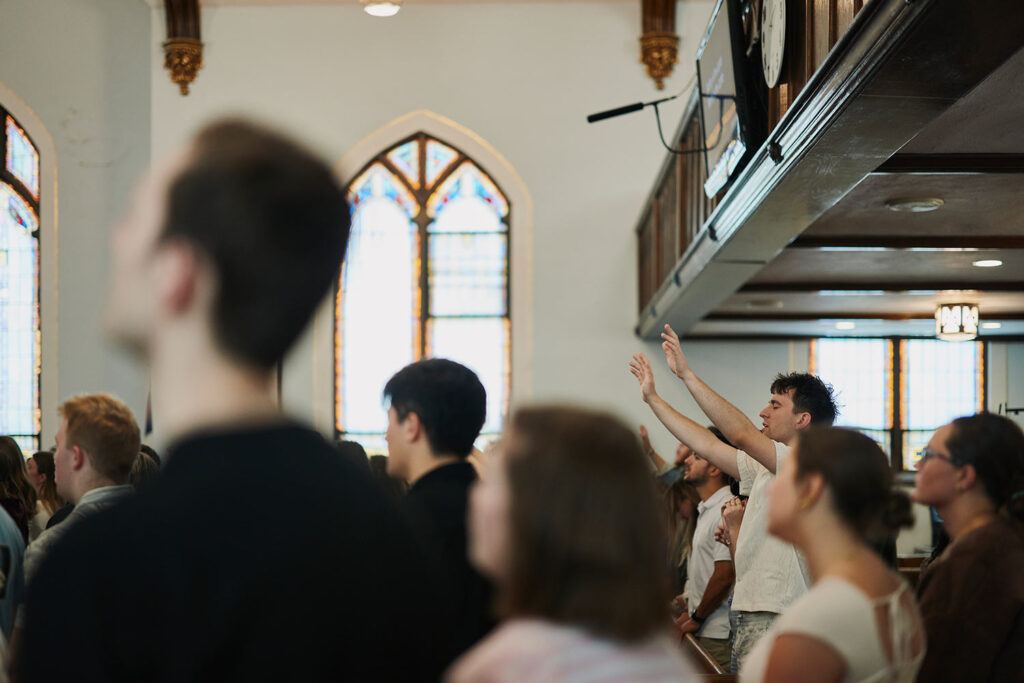
An important aspect of student evangelism is group evangelism. When I say that, I’m really talking about those moments when we intentionally gather people together and encourage students to bring their lost friends. Maybe it’s a worship night, an outreach event, a weekly gathering, or an evangelistic service. Whatever the context is, the question becomes: how do we actually make those moments count?
Culture has shifted. Young people today are not naturally religious. Cultural Christianity is disappearing. Fewer and fewer students are growing up in Christian homes or walking into church with a basic understanding of Christianity. Most of the lost students showing up to our ministries are there because somebody invited them. A friend brought them. They trusted someone enough to come sit in the room. That means we need to think intentionally about what they experience when they get there.
I remember the first time I went to church. My parents became Christians when I was 16, but I didn’t become a Christian until I was 21. So, when I first walked into church as a teenager, I was completely confused. The worship band was on stage and asked everyone to stand up, sit down, stand up again, turn around, hug someone, and sit back down. I was thinking, What is happening right now?
Then they did a baptism, and that really blew my mind because I’d never seen a baptistry before. I remember thinking, This church is legit. They’ve got a hot tub in here. I didn’t understand church culture at all. I didn’t know the language. I didn’t know the routines. I didn’t know the expectations. But here’s what I did want to know: was there really Someone who could change my life? Later, I found out His name was Jesus.
That’s why we must be intentional anytime we gather students together for evangelistic purposes. We can’t just assume people understand church culture or know what we mean. We need to think strategically and missionally about how we engage spiritually lost people when they show up.
1. Pray Like God Is the One Who Saves
If we’re going to create evangelistic environments, prayer must come first. Prayer is the fuel behind everything. At the end of the day, only God can save people. So why would we spend all our time talking to people about salvation without first talking to the only One who can actually save them?
If we want God to move, we need to pray. Every great awakening started with prayer. Every movement of God was preceded by people crying out to Him. So before the event happens, pray. During the event, pray. After the event, pray and thank God for what He’s done. Pray over the room. Pray over the leaders. Pray over the students bringing friends. Pray for lost people by name. Pray for boldness. Pray for opportunities. Pray that the Holy Spirit would draw people to Jesus.
Too often, we treat prayer like the warm-up instead of the work itself. But prayer is not preparation for ministry. Prayer is ministry.
2. Do the Work to Get Lost People in the Room
One of the biggest mistakes we make with evangelistic events is calling something evangelistic without actually doing the work to get spiritually lost people there. I can’t tell you how many times I’ve been invited to speak at an “evangelistic event” where the expectation was for me to preach the gospel and give an invitation, but no one had intentionally invited lost people.
So what ends up happening? I’m standing in front of a room full of Christians telling found people how to be found. Now, don’t get me wrong. Believers need to hear the gospel, too. We all do, but if we’re calling something an evangelistic event, then we need to actually think missionally about who is in the room.
Have we equipped students to invite friends? Have we challenged them to bring spiritually lost peers? Have we created an environment where lost people can show up and feel welcomed? Have we intentionally engaged people outside our normal church circles? Those things matter.
A lot of ministries want the results of evangelism without doing the relational work of evangelism. But somebody has to invite the lost friend. Somebody has to start the conversation. Somebody has to build trust with people far from God. If we want spiritually lost people to hear the gospel, we have to intentionally go after them.
3. Preach the Gospel Clearly
If we’re going to host evangelistic events, then we need to actually preach the gospel. That sounds obvious, but sometimes we invite people to respond to Jesus without ever clearly explaining who Jesus is and what He’s done.
There are billions of people on this planet, thousands of people groups, and thousands of languages. But underneath the diversity is one common need: every person needs Jesus. Outside the walls of our ministries is a hopeless world, a joyless world, a world full of conflict and death. And what we know is this: hope has a name, joy has a name, peace has a name, and life has a name. That name is Jesus.
So let people hear about Him. Not just our stories, jokes, illustrations, or production. Jesus.
Because if we ask people to respond without preaching the gospel, then what exactly are we asking them to respond to? Emotional manipulation? A moving moment? A good atmosphere? No. We want people responding to Jesus because they’ve heard the good news about Jesus.
The same gospel that has transformed lives for over 2,000 years still has power today. Romans 1:16 says the gospel is “the power of God for salvation to everyone who believes.” That’s still true. We don’t need a new message. We need faithful messengers willing to proclaim the gospel with confidence and clarity.
4. Stop Winging the Invitation
If you’re going to preach the gospel, then invite people to respond to the gospel. And whatever that looks like in your ministry context, do it clearly. Maybe your context involves walking forward publicly. Maybe it’s a conversation room afterward. Maybe students text a number or fill out a card. The method may vary depending on your context, but the principle remains the same: give people a clear opportunity to respond to what they’ve heard.
I was flying on a small plane not too long ago, and when we landed, we got off directly onto the tarmac. As I was walking away from the plane, I saw this giant metal sign attached to a fence that said: “These moving propellers rip heads off.” Now that is clear communication. I immediately understood the assignment. Stay away from the propellers.
Sometimes when we give gospel invitations, we get nervous and become incredibly unclear. We mumble through things. We overcomplicate things. We say vague spiritual phrases that nobody understands. Be clear.
And here’s a cheat code for clarity: prepare your invitation ahead of time. Most communicators prepare their sermons. They know their points, illustrations, and Scriptures. But then they get to the invitation and completely wing it. Suddenly all their confidence disappears, and they start stumbling over their words. Why? Because they prepared the sermon but not the invitation.
Know what you’re inviting people to do. Know what Scriptures you want to use. Know how you want to explain repentance and faith. Yes, stay sensitive to the Holy Spirit, but preparation and Spirit-led ministry are not enemies. You can be prepared and dependent on God at the same time.
5. Build a Follow-Up Plan Before the Event Starts
One of the most irresponsible things we can do is work hard to get spiritually lost people into the room, preach the gospel, see people respond, and then never follow up with them afterward. That’s not discipleship.
If students place their faith in Jesus, we need a plan for what happens next. How are we collecting information? Who is following up? How are we helping them take their next steps? How are we connecting them to baptism, community, and discipleship?
The Great Commission does not say, “Go make converts.” Jesus said to make disciples. And honestly, I think a lot of ministries don’t struggle because they failed to present the gospel well. They struggle because they never created intentional systems to disciple people. That’s where things often fall apart.
We need to help students grow in their faith. We need to connect them to biblical community. We need to walk with them. We need to help them understand that following Jesus is not a one-time decision but the beginning of a lifelong journey of discipleship.
Trust the Power of the Gospel
I know a lot of people get nervous when it comes to evangelism. They think, I’m not gifted enough, or I’m not as good a communicator as someone else. I love what George Whitefield once said: “Others may preach the gospel better than I, but no one can preach a better gospel.”
Some people may communicate better than you. Some people may be funnier, smarter, or more polished than you. But nobody has a better gospel than the one you’ve already been entrusted with. The gospel works. The gospel saves. The gospel changes lives.
So pray boldly. Invite intentionally. Preach clearly. Call people to respond. Follow up faithfully. And trust Jesus to do what only Jesus can do.
____________________________________________________________________________________
Adapted from the Creating a Culture of Evangelism Online Course. Learn more and take the course for student leaders or collegiate leaders.
Published June 25, 2026
